

Disclaimer: Mladysrecords. This site provides fashion and lifestyle content for informational purposes only.
A weekend in a new city is one of the most efficient ways to reset — two days, one bag, and the right decisions made in advance. The challenge isn’t motivation; it’s compression. You have roughly 48 hours to experience a place without burning them on logistics, bad meal choices, or neighborhoods that don’t deliver. Most people underplan the practical side and overplan the itinerary. The result is a trip that looks full on paper but feels rushed on the ground. Getting the balance right requires a different kind of preparation than a week-long vacation.
Choosing the Right City for a Short Trip
Not every destination earns a weekend. A city that rewards slow exploration — one built around wandering, stumbling into markets, and sitting in cafes — will serve a two-day trip far better than one where the best experiences require long drives or advance booking windows measured in months.
Distance matters more than people admit. A three-hour flight with a one-hour connection eats roughly ten hours of a 48-hour trip before you’ve left the airport the second time. Direct flights under two hours, or drives under four hours, change the math completely. For a weekend format, proximity to home base is often the most underrated selection criterion.
Once you’ve settled on a destination, assess the city’s walkability score alongside its public transit reliability. Cities where you can move between neighborhoods on foot or via a frequent subway line eliminate the taxi-or-rideshare decision entirely — which adds up in both cost and decision fatigue. A neighborhood-based trip, where you anchor in one or two areas and explore them deeply, consistently outperforms the checklist approach of hitting every landmark across a sprawling metro.
Building an Itinerary That Leaves Room to Breathe
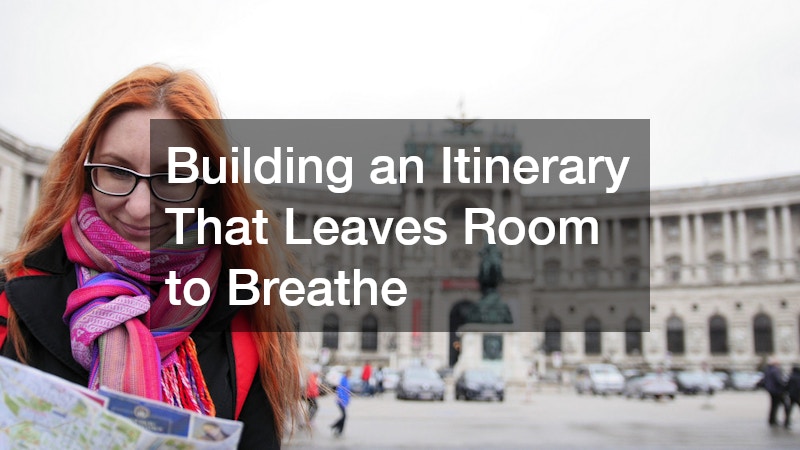
The most common weekend trip failure isn’t under-scheduling — it’s over-scheduling. Blocking every hour with activities removes the margin that makes travel enjoyable. The goal is a loose structure, not a military operation.
A practical framework: identify one anchor experience per half-day. That’s four anchors across the weekend. Everything else — the coffee shop, the bookstore, the unexpected detour — fills itself in. Anchor experiences are the ones that genuinely require advance booking or fixed timing: a museum with timed entry, a restaurant with limited reservations, a walking tour that runs once daily. Everything else should stay flexible.
When comparing a structured tour versus self-guided exploration, the trade-offs are real. Structured tours concentrate expertise into two to three hours and remove navigation friction, which is valuable in a dense historical district you’d otherwise misread. Self-guided exploration rewards curiosity and allows pace changes, but works best when you’ve done enough research to know what you’re looking at. For a first visit to a city, one structured experience on day one followed by self-guided time on day two is a reliable combination.
- Book anchor experiences at least three weeks out, especially for weekend dates between April and October when urban tourism peaks
- Allow 90 minutes of unscheduled buffer per day — not as backup time, but as intentional margin
- Download offline maps for your core neighborhood before departure, covering at least a one-mile radius around your hotel
Accommodation and the Neighborhood Decision
Where you stay determines how the trip feels more than almost any other factor. A hotel in the right neighborhood means you wake up already inside the experience. A hotel chosen for price alone, three miles from where you want to spend your time, costs you in rideshare fees and momentum.
The central-versus-local debate is worth resolving deliberately. A centrally located hotel — typically priced $40 to $80 per night higher than equivalent properties two neighborhoods out — often pays for itself in transportation savings and convenience, particularly if you’re visiting for only two nights. The math shifts for travelers who prioritize one specific neighborhood over city-wide access.
Boutique hotels and independently operated guesthouses tend to offer better neighborhood integration than large chain properties. Staff recommendations at smaller properties are frequently more current and specific than those at chain hotels, where front desk guidance is often standardized across properties nationwide.
- Compare walkability scores on neighborhood maps before booking, not after — aim for a score above 80 if you plan to rely on foot travel
- Read recent reviews filtered to the last 60 days; construction noise, renovation projects, and service changes don’t show up in older ratings
- Confirm the check-in window before booking if your flight lands before noon
Food Strategy for a Time-Limited Trip
Two days isn’t enough time to eat everywhere you want, so the decision about where to prioritize is consequential. Spreading meals across too many types of experiences — the upscale dinner, the food market, the trendy brunch spot, the late-night snack — creates a fragmented rhythm. Choosing a culinary focus sharpens the trip.
For cities with strong food identities, leaning into the local specialty rather than sampling broadly tends to produce more memorable meals. If Mexican food is the city’s strength, doing it properly — finding the best Mexican restaurant rather than settling for the most convenient block — is worth the extra fifteen minutes of research before you leave home.
Lunch reservations are significantly easier to secure than dinner slots and frequently offer similar menus at lower prices. The gap between a $22 lunch entrée and a $38 dinner version of the same dish is common in urban restaurants, particularly at mid-to-high tier establishments.
- Make no more than one dinner reservation per night; leave the second meal open for flexibility
- Research food halls or covered markets in your target neighborhood — they compress variety into a single location and work well for quick lunches
- Factor meal timing into your itinerary; a 1:00 p.m. reservation near a museum you’re visiting at 11:00 a.m. preserves flow rather than breaking it
Packing for Efficiency Without Sacrificing Comfort

Weekend trips expose the gap between what people think they need and what they actually use. Most travelers overpack for 48 hours. A carry-on with a structured packing system outperforms a checked bag on every dimension — speed, flexibility, and the elimination of baggage claim time, which routinely adds 25 to 40 minutes to an arrival.
The real packing decision is footwear. Shoes are the heaviest and most space-consuming items in a weekend bag. Wearing your bulkiest pair on travel days and packing one additional pair covers most urban itineraries. A second pair should be chosen based on the single most specific activity planned — cobblestones, a rooftop bar, a long museum visit — not as a general backup.
Clothing choices work best when built around a consistent color palette of three to four tones. Neutral-anchored outfits pack smaller, require less planning on the ground, and allow pieces to work across contexts — a Friday dinner, a Saturday gallery, a Sunday morning walk — without looking repetitive.
- Pack a crossbody or packable daypack for urban walking; backpacks signal tourist, crossbodies integrate better and reduce pickpocket risk
- Limit toiletries to carry-on compliant 3.4 oz containers and bring only what you’ll use in 48 hours — hotel properties above two-star typically supply shampoo, conditioner, and soap
- Lay out your full outfit plan the night before departure, accounting for weather forecasts specific to your destination dates
Making the Most of Your Return Day
Sunday often gets sacrificed to airport logistics and fatigue. Treating the return day as a half-loss before it begins is a self-fulfilling outcome. With a late-afternoon or evening flight, Sunday morning and early afternoon remain fully usable — and often more enjoyable than Saturday, when you’re still adjusting to the city.
The smartest approach is to store luggage at the hotel or at a luggage storage service near your departure point, then reclaim the morning for one final unhurried experience. Most urban hotels will hold bags until 6:00 p.m. without charge if asked directly at checkout.
Avoid scheduling anything on return day that requires a reservation or a fixed window. Let it be the unstructured half of the trip — the walk, the independent coffee shop, the neighborhood you didn’t get to. That open time frequently produces the sharpest memories of the whole trip.
When You’re Ready to Book Your Next One
The gap between a good weekend trip and a genuinely memorable one usually comes down to decisions made in the two weeks before departure, not the 48 hours of the trip itself. Anchor the destination choice in logistics, not inspiration. Let the itinerary breathe. Choose the neighborhood before you choose the hotel. Treat Sunday like a full day. None of this requires more money or more time — it requires earlier and more deliberate choices. A well-planned weekend in a city you’ve never explored is one of the better investments in perspective available at this price point.
